
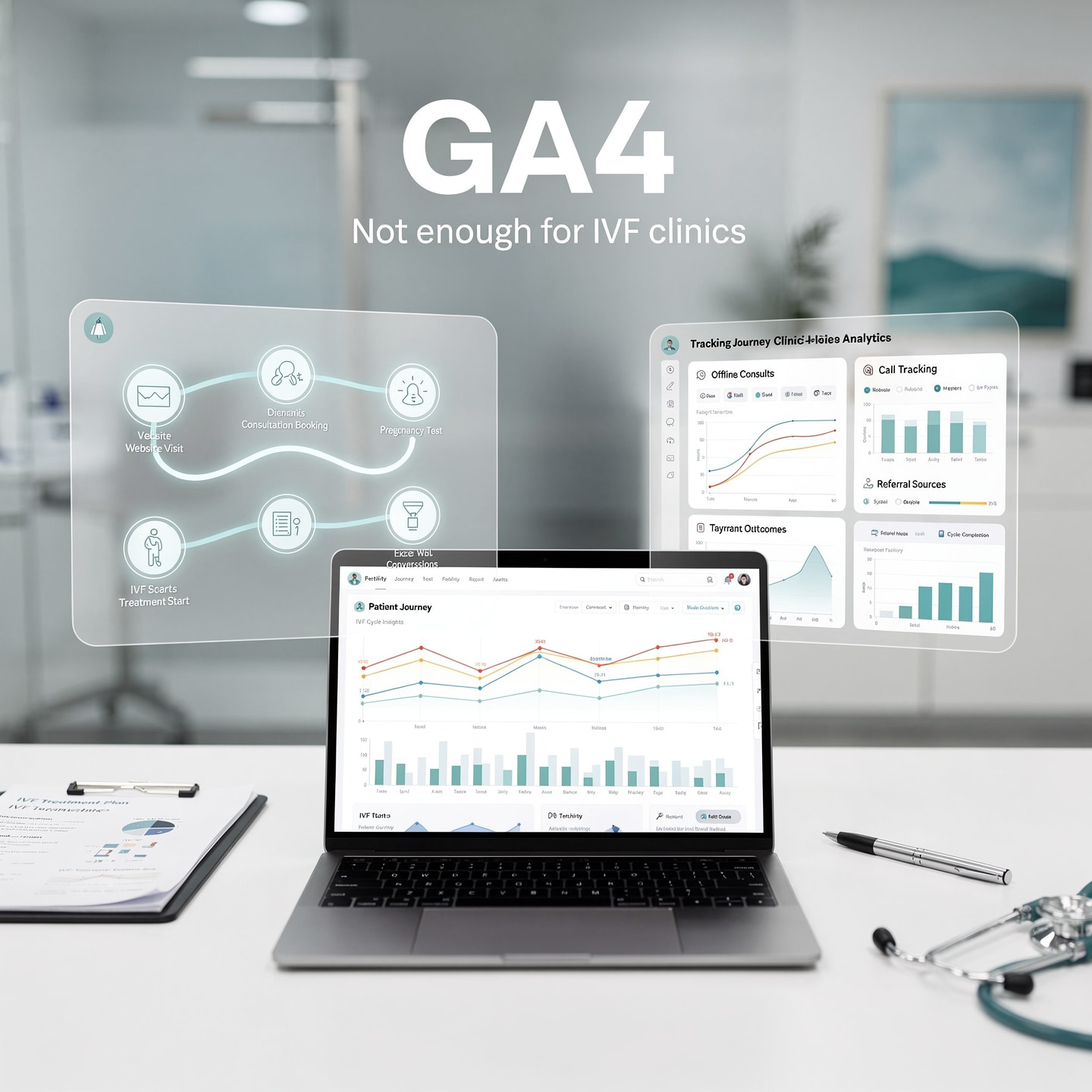
Why GA4 Is Not Enough for IVF Clinics
GA4 is insufficient for IVF clinics because it only tracks top of funnel browser activity and cannot measure critical offline conversions like phone call outcomes, consultation show rates, or treatment starts. To gain a complete view of marketing ROI, clinics must supplement GA4 with HIPAA compliant call tracking and CRM integrations that bridge the gap between a website form submission and an actual patient booking.
You're the marketing manager at an IVF clinic. You pull up GA4 and see 500 form submissions last month. Great news? But when you check with the front desk, they only logged 350 actual patient contacts. Where did the other 150 conversions go?
This isn't a tracking error. It's a fundamental gap in how GA4 for fertility clinic measurement works. GA4 excels at tracking traffic sources and basic on-site events like form fills, but it wasn't built for how IVF patients actually convert. Most fertility clinics receive far more new patient leads from phone calls than web forms, and GA4 can't track those calls, offsite booking completions, or response-time operations that determine whether a lead becomes a consultation.
This article will show you what GA4 does well, identify the specific measurement gaps for IVF clinics, and recommend a practical measurement stack that fills those holes. We're not attacking GA4 - it's solid. But fertility clinics need complementary tools to make confident decisions about campaigns and website performance.
Key Takeaways
GA4 tracks website traffic and form submissions effectively, but it stops at the browser and cannot measure what happens after a lead submits a form or calls your clinic, leaving you blind to consultation bookings, show rates, and treatment starts.
Phone calls generate more IVF patient leads than web forms at most fertility clinics, yet GA4 only tracks click-to-call button clicks without capturing call quality, duration, outcomes, or whether prospects actually booked appointments.
Cross-domain tracking failures create major attribution gaps when prospects book through third-party schedulers like Calendly or Acuity, with drop-off rates reaching 40-60% between scheduler clicks and completed bookings that GA4 cannot measure.
IVF clinics need a complete measurement stack beyond GA4: HIPAA-compliant call tracking integrated with your CRM, booking scheduler integration with completion tracking, and real-time dashboards that measure cost per consultation and cost per treatment start, not just cost per lead.
What GA4 Does Well
GA4 for fertility clinic marketing gives you solid visibility into traffic and campaign performance. You can see which channels drive visitors - organic search, paid ads, referrals, direct traffic - and UTM parameters let you track specific campaigns down to the ad level.
Pageview and session data shows which treatment pages prospects visit and how long they engage. Form submission tracking works reliably when forms live on your domain and you've configured them as conversion events.
In 2026, GA4's predictive capabilities have matured significantly. It models missing data from privacy restrictions, predicts patient behavior patterns, and integrates with Google Ads machine learning for smarter bidding. Data-driven attribution distributes conversion credit across touchpoints based on actual data - the right choice for most advertisers now.
GA4 excels at straightforward questions: "How many people visited our IVF treatment page?" or "Which ad campaign drove the most website traffic?"
Where GA4 Falls Short in IVF
The fundamental limitation: GA4 stops at the browser. When a prospect fills out your consultation form, GA4 logs that conversion but has zero visibility into what happens next. Did the lead call? Did your front desk respond? Did they book a consultation? Did they show up? GA4 can't tell you.
This matters more in IVF than most industries because sales cycles stretch across weeks or months. GA4's default session-based tracking struggles to capture touchpoints spread over multiple visits, making attribution incomplete at best.
Cross-domain tracking adds another layer of complexity. If your booking scheduler lives on a third-party domain, GA4 often loses the thread entirely. The patient journey looks broken even when it's not.
Beyond these core issues, GA4 can't distinguish between information-seekers and high-intent prospects without additional tools, and standard reports have a 24-48 hour processing delay before conversion data appears, though Real-Time reports provide immediate verification.
The Missing Conversions: Calls and Booking Completion
For most fertility practices, phone calls outnumber form submissions by a significant margin - yet GA4 for fertility clinic tracking treats calls as an afterthought.
GA4 can log click-to-call button clicks, but it can't tell you call quality, duration, or whether the prospect actually booked an appointment. Fertility clinic call tracking fills this gap by identifying unanswered calls, voicemails, and hang-ups - the operational insights that actually impact conversion rates.
The second blind spot: booking completions. When a prospect clicks your scheduler link and moves to Calendly or Acuity, GA4 loses them. You see the click but not the completion.
| Conversion Type | GA4 Capability | IVF Clinic Requirement | Gap |
|---|---|---|---|
| Form Submissions | Tracks completions | + CRM integration | Post-form follow-up |
| Phone Calls | Tracks button clicks | Call quality, outcome | Everything that matters |
| Booking Completions | Tracks link clicks | Actual appointment booked | Off-domain completion |
Both channels should feed into a HIPAA-compliant CRM to track true IVF clinic conversion tracking: consultation shows and treatment starts.
Why Attribution Breaks on High-Intent Pages
GA4 for fertility clinic tracking shows aggregate traffic to your site, but it can't tell you whether your Facebook ads send prospects to blog posts about stress management or to your egg freezing pricing page.
That distinction matters. High-intent pages - IVF cost calculators, success rate data, specific treatment pages for PGT-A or donor programs - convert at vastly different rates than informational content. Without page-level attribution by campaign, you're flying blind on which channels drive serious inquiries versus casual browsers.
The attribution challenge compounds across IVF's extended sales cycle. GA4's default models show last-click or data-driven attribution, but they can't connect an initial awareness touch to a consultation booking three weeks later without CRM integration. You lose visibility into lead-to-consultation rates, show rates, and downstream treatment starts.
Response-time operations live entirely outside GA4: speed-to-lead tracking, missed call recovery, after-hours inquiry management. Lead management technology increases conversion rates by 3x because faster response directly impacts booking likelihood.
What IVF Clinics Should Measure Beyond GA4
The metrics that actually matter start where GA4 stops: after the form submission or phone call.
We've found that the most revealing metric is campaign-level ROI calculated by cost per consultation booking - not just cost per lead - and cost per treatment start. This tells you whether your Facebook ads are generating consultations or just tire-kickers.
Pair that with detailed call tracking by marketing source. You need outcome data: booked appointments, not interested, follow-up needed, wrong number. This operational layer shows which campaigns drive quality phone leads.
For clinics using offsite booking schedulers like Calendly or SimplePractice, track completion rates - how many prospects who click your scheduler link actually book. We've seen this drop-off reach 40-60% at some practices.
Response time metrics matter too: time from form submission to first contact, missed call recovery rate, and after-hours inquiry handling. These operations directly impact whether your marketing spend converts to consultations.
Finally, tie page-level engagement on treatment-specific pages back to campaign source for true IVF marketing attribution.
The Measurement Stack We Recommend
Keep GA4 for website traffic and on-site behavior analysis, then layer three additional tools on top.
HIPAA-compliant call tracking that feeds your CRM system. This lets you track lead handling quality, conversion to office visits and IVF cycles, and calculate true ROI by determining which marketing channel every treatment start originated from.
Booking scheduler integration with UTM parameter passing and completion event tracking to bridge the attribution gap when prospects book through offsite platforms.
Real-time dashboard platform providing visibility into time until next available appointment, referral source performance, and conversion rates from new patient consultations to IVF cycles.
Technical requirements: ensure cross-domain tracking setup, UTM parameter consistency across all campaigns, and HIPAA compliance for all tracking tools.
Here's what this stack delivers:
| Capability | GA4 Alone | Complete Stack | Business Impact |
|---|---|---|---|
| Form Conversions | Submissions only | Through to consultation | See actual lead quality |
| Call Tracking | Click events only | Full attribution + outcomes | Capture primary channel |
| Booking Completion | No offsite visibility | Tracks completion + source | True conversion rate |
| ROI per Campaign | Traffic metrics | Revenue per dollar spent | Optimize ad investment |
Start with call tracking - it delivers the highest immediate ROI.
What to Do Next
GA4 for fertility clinic tracking is valuable - it shows traffic sources, campaign performance, and basic conversions. But it can't track the metrics that determine whether your marketing actually works: phone call outcomes, offsite booking completions, page-level attribution for high-intent content, or response-time operations.
The clinics making confident marketing decisions layer GA4 with call tracking, CRM integration, and booking completion monitoring. That stack reveals cost per consultation and cost per treatment start - the numbers that matter.
If you're unsure what's missing in your current setup, we offer a free IVF Marketing Measurement Audit. We'll review your GA4 configuration, identify blind spots in call and booking attribution, and deliver a customized measurement stack recommendation. No generic advice - just specific gaps and practical fixes for your clinic.
FAQ
Can GA4 track phone calls from my IVF clinic website?
GA4 tracks click-to-call button clicks as events, but that's where it stops. It can't tell you whether the prospect actually called, how long the call lasted, whether they reached a person or got voicemail, or if they booked an appointment. For that visibility, you need dedicated call tracking software with dynamic number insertion that assigns unique phone numbers to different marketing sources and records call outcomes.
How do I track booking completions when my scheduler is on a different domain?
Set up cross-domain tracking in GA4 and ensure UTM parameters pass through to your booking platform. Most schedulers like Calendly support GA4 integration, but you'll need to configure it manually in both systems. A more reliable option: use booking platform webhooks that send completion data directly to your CRM, bypassing the attribution gap entirely and giving you definitive booking confirmation tied to the original traffic source.
What's the difference between a lead and a conversion for IVF clinics?
A lead is contact information captured - someone filled out a form or called your clinic. A conversion is a booked consultation or treatment start. GA4 typically tracks leads (form submissions, call button clicks), but what you actually care about is whether that person showed up for a consultation and started treatment. The gap between these metrics reveals your true marketing performance and operational efficiency.
Do I need HIPAA-compliant tracking tools?
Yes. When patients call to schedule appointments, they often share protected health information - symptoms, medical history, treatment questions. As a healthcare organization, you're responsible for ensuring all vendors handling this data are HIPAA-compliant. That includes call tracking services, CRM systems, and any platform that might capture patient communications. Regular analytics tools don't meet this standard.
How much does a complete measurement stack cost compared to just using free GA4?
HIPAA-compliant call tracking runs $200-500 monthly. Booking schedulers with analytics cost $50-200 monthly. CRM integration varies by system. Total investment: roughly $300-800 per month. This pays for itself quickly by identifying which campaigns actually drive consultations versus wasting budget on traffic that never converts. One prevented bad campaign decision covers months of tracking costs.