
Why Data Freshness in Healthcare Dashboards Is a Board-Level Confidence Problem
Data freshness in healthcare dashboards is a critical confidence metric because accurate conversion numbers are operationally useless if the underlying lifecycle status data is outdated. To maintain board level trust, clinics should monitor the 95th percentile of status delay and apply a confidence discount to any reporting that exceeds a 48 hour threshold.
#5 | Irresist IVF Insights
Every clinic leader knows the Monday morning ritual: open the dashboard, scan the conversion numbers, and confirm things look clean. The numbers are precise, the layout is sharp, and the meeting starts on time. But there's a question almost nobody asks: how current is the lifecycle status data behind those numbers?
Dashboard accuracy and dashboard timeliness are two distinct qualities, and most reporting setups treat them as a single entity. A conversion metric can be calculated correctly and still describe a reality that has already changed. In IVF operations, where intake speed, follow-up discipline, and movement through high-consideration stages shape every conversion outcome, that gap between "accurate" and "current" carries real cost.
The metric that separates visually polished reporting from operationally current reporting is status_freshness_p95_hours. At Irresist, we check it before we trust a board-level number. All chart values referenced in this article are illustrative and designed to explain the metric, not to represent any specific client data.
Key takeaways
Freshness is a confidence metric -
status_freshness_p95_hoursmeasures how delayed lifecycle status updates are for 95% of records reaching the reporting layer.Precise dashboards can still be late - A polished conversion rate built on 60-hour-old status data describes the past, not the present.
The 48-hour line is a decision boundary - Above it, operational readings deserve a confidence discount; below it, the dashboard earns its precision.
Stale data distorts specific decisions - Intake prioritization, board-level conversion reviews, and follow-up scoring all break when lifecycle statuses lag.
Freshness needs named ownership - Monitoring without a response policy produces alerts nobody acts on.
What status_freshness_p95_hours actually measures
In plain terms, status_freshness_p95_hours is the 95th percentile of time between a lifecycle status update in the source system and the moment the reporting layer evaluates it. "95th percentile" means 95% of records are at or below that delay, so this metric captures the experience of nearly all records rather than just the average.
A lifecycle status is any state-of-record update that signals a patient has moved through the funnel: lead_created, became_patient, service_started. The reporting layer is whichever dashboard or analytics tool the clinic uses, regardless of software stack.
What does a given freshness value mean for decision quality? The table below offers an illustrative guide.
Freshness value (illustrative) | Reporting band | What it means for decision quality |
|---|---|---|
Under 12h | Green | High confidence. Operational decisions are well supported. |
12h - 48h | Amber | Monitor closely. Some lag exists; verify time-sensitive readings. |
Above 48h | Red | Low-confidence threshold breached. Treat operational readings with extra scrutiny. |
The precision illusion: when dashboards look right but run late
A dashboard showing a 34.2% conversion rate isn't wrong. But if the lifecycle statuses feeding that number are 60 hours old, the clinic is reading a report from two and a half days ago. This is more dangerous than a broken dashboard. A broken dashboard signals a problem. A stale-but-polished dashboard invites confident action on outdated data.
Consider an IVF-specific scenario: a follow-up manager reviews the intake pipeline at 9 am and sees 12 leads in the consultation-booked stage. Two of those leads actually cancelled yesterday, but the status update hasn't reached the reporting layer yet. The team skips re-engagement calls because the pipeline looks healthy. IVF reporting latency like this doesn't announce itself.
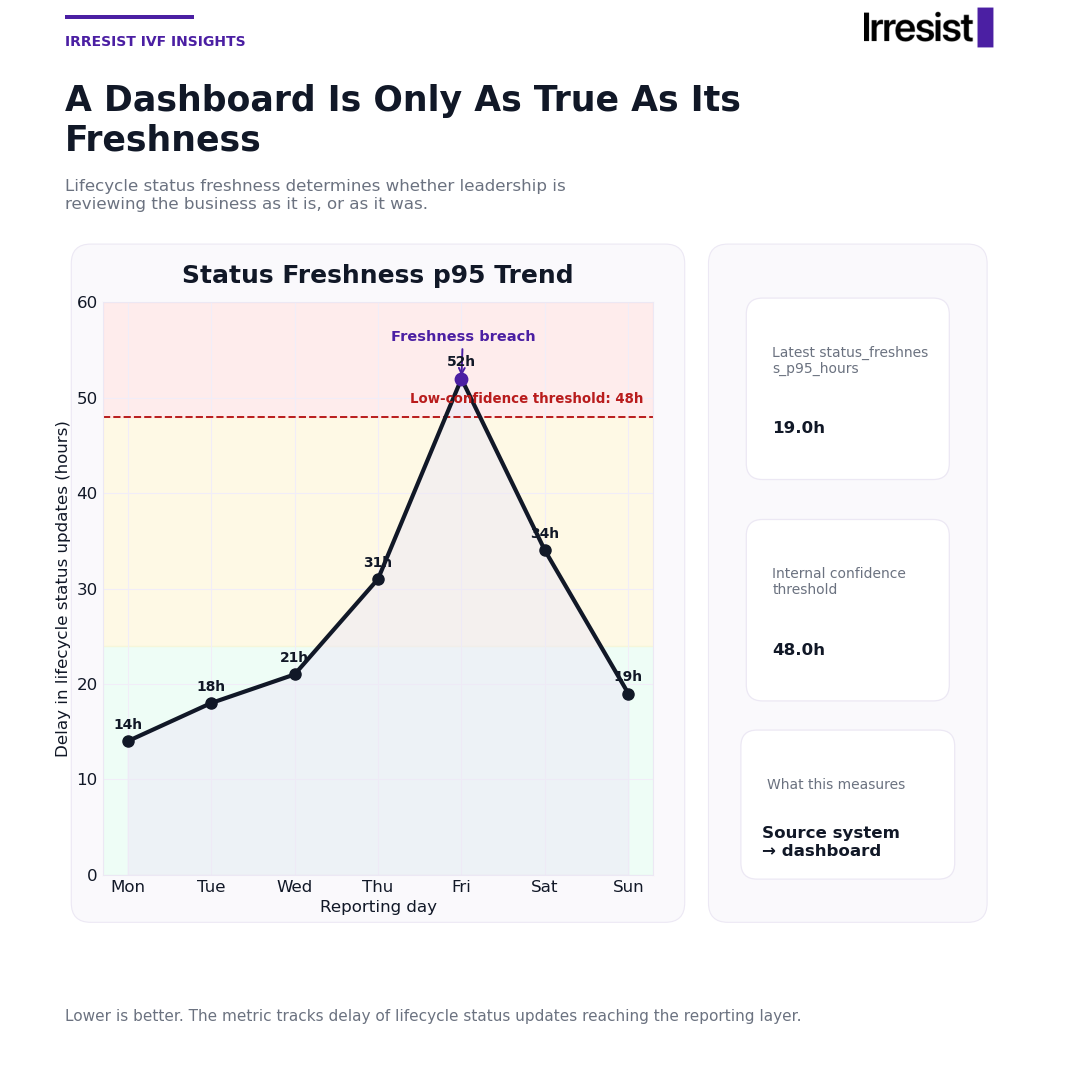
The 7-day trend visualization described in this article's companion graphic, with green, amber, and red bands, shows how data freshness in healthcare dashboards degrades and recovers over time. The dashed line at 48h marks the dashboard low-confidence threshold. This issue is structural, not a one-off glitch. Freshness degrades silently unless actively monitored.
The 48-hour low-confidence threshold
A low-confidence threshold is a pre-defined freshness level above which the dashboard should be treated as less trustworthy for real-time operational decisions. The 48h line doesn't mean the dashboard is broken. It means leadership should apply a confidence discount to any time-sensitive operational reading.
The right threshold value is configurable and should reflect the operational tempo of each clinic. For IVF practices with active weekly intake cycles, 48 hours is a sensible illustrative benchmark. Below the threshold, the dashboard earns its precision. Above it, the precision becomes a liability because it implies certainty the data doesn't support.
At Irresist, this threshold is embedded in the dashboard quality logic as a named, visible signal rather than a hidden assumption.
Bad decisions that stale lifecycle status produces
Lifecycle status delay distorts specific decision types in IVF operations.
Intake prioritization - The team ranks leads by recency of last status update, but if the status layer lags, a lead who has already scheduled elsewhere still appears active and receives follow-up resources that could go to genuinely open prospects.
Conversion reporting to leadership - A board-level conversion metric is presented at Monday's review. The underlying status data is 55 hours old. The team celebrates a strong intake week that had already softened by Friday afternoon.
Follow-up discipline scoring - A manager assesses whether the team is hitting response windows, but the lifecycle timestamps used to calculate response time are delayed, making performance look better than it is.
Freshness isn't a data quality edge case. It sits directly in the decision path for patient acquisition.
Freshness ownership: who acts when the threshold breaches
Monitoring freshness without an ownership policy produces alerts nobody acts on. The table below proposes a three-role model. Values are illustrative.
Role | Trigger condition | Responsibility | Escalation path |
|---|---|---|---|
Data / Analytics Owner | Freshness enters the amber band | Investigate the source of the delay; assess scope | Notify Operations Lead if the delay persists |
Operations Lead | Freshness exceeds the 48h threshold | Apply confidence discount; inform dashboard consumers | Escalate to the Clinic Director if unresolved within the shift |
Clinic Director | Freshness stays above threshold 24h+ | Pause operational decisions based on the dashboard; require manual verification | Engage the vendor or technical team for root-cause resolution |
This matters most in clinical environments where dashboard consumers (patient coordinators, directors) aren't the same people who can diagnose a freshness problem. The threshold breach should be visible inside the dashboard itself, not buried in a separate monitoring tool.
At Irresist, freshness is treated as a confidence signal rather than a background infrastructure metric, which changes how dashboard consumers interact with the numbers they see.
If freshness worsens, do this
When status_freshness_p95_hours crosses the low-confidence threshold, follow this response playbook:
Identify scope - Determine whether the delay affects all lifecycle stages or specific ones, such as stages sourced from a particular intake tool or CRM integration.
Apply a confidence discount immediately - Inform dashboard consumers that current readings should not be used for same-day operational decisions without manual verification.
Trace the delay source - Check whether the lag originates in the source system update frequency, the integration pipeline, or the reporting layer's evaluation cadence.
Communicate upward - If a board review or weekly leadership meeting is imminent, note the freshness status explicitly so recipients understand the confidence level of the numbers being presented.
Restore and verify - Once freshness returns below the threshold, confirm that the reporting layer has processed the backlog of status updates before treating the dashboard as current again.
Share this playbook with anyone who uses the dashboard for operational decisions, not just the technical team.
The bottom line
Operational reporting timeliness is a confidence problem, not just an infrastructure problem. status_freshness_p95_hours gives clinic leaders a single, readable number that answers: "Can I trust this dashboard for today's decisions?" If you don't measure it, you're treating every dashboard reading as equally current, and that assumption will eventually cost you a decision.
If you're building or reviewing your IVF reporting stack and freshness isn't a visible, named metric in your dashboard, that's the first thing to fix. At Irresist, we build freshness into the reporting layer so that confidence is part of the view, not something you have to guess. Visit irresist.io to see how we treat data quality as a first-class reporting signal.
FAQ
What is status_freshness_p95_hours, and why does it matter for IVF dashboards?
status_freshness_p95_hours is the 95th percentile of delay between a lifecycle status update in the source system and the moment the reporting layer evaluates it. It matters for IVF dashboards because patient conversion reporting depends on timely lifecycle updates, like lead_created or became_patient. If 95% of records are lagging significantly, the dashboard may look precise while reflecting a reality that's already changed.
How do I know if my dashboard has a data freshness problem?
The clearest signals are the absence of signals: no visible freshness metric on the dashboard, no threshold indicator, and no way to tell when lifecycle statuses were last updated. If you can't answer "how old is this data?" while looking at your dashboard, you likely have an unmonitored freshness gap.
What is a reasonable low-confidence threshold for IVF reporting?
48 hours is a sensible illustrative benchmark for IVF practices with active weekly intake cycles. The right threshold depends on your operational tempo and how frequently leadership reviews pipeline data. Clinics with daily intake reviews may need a tighter threshold; those with weekly cycles may find 48 hours appropriate.
Who should own the freshness metric in a clinic's reporting setup?
Ownership should be named, not assumed. The article's policy model assigns primary monitoring to the data or analytics owner, operational response to the operations lead, and escalation authority to the clinic director. Without named roles and trigger conditions, freshness alerts become noise that nobody acts on.
Can a dashboard be accurate and still be operationally late?
Yes. A dashboard can calculate every metric correctly and still describe a reality that no longer exists. Accuracy means the math is right. Timeliness means the inputs are current. When lifecycle statuses are delayed, the dashboard is precise about the past, while the business has already moved on. That's the precision illusion, and it's more dangerous than a visibly broken report.