
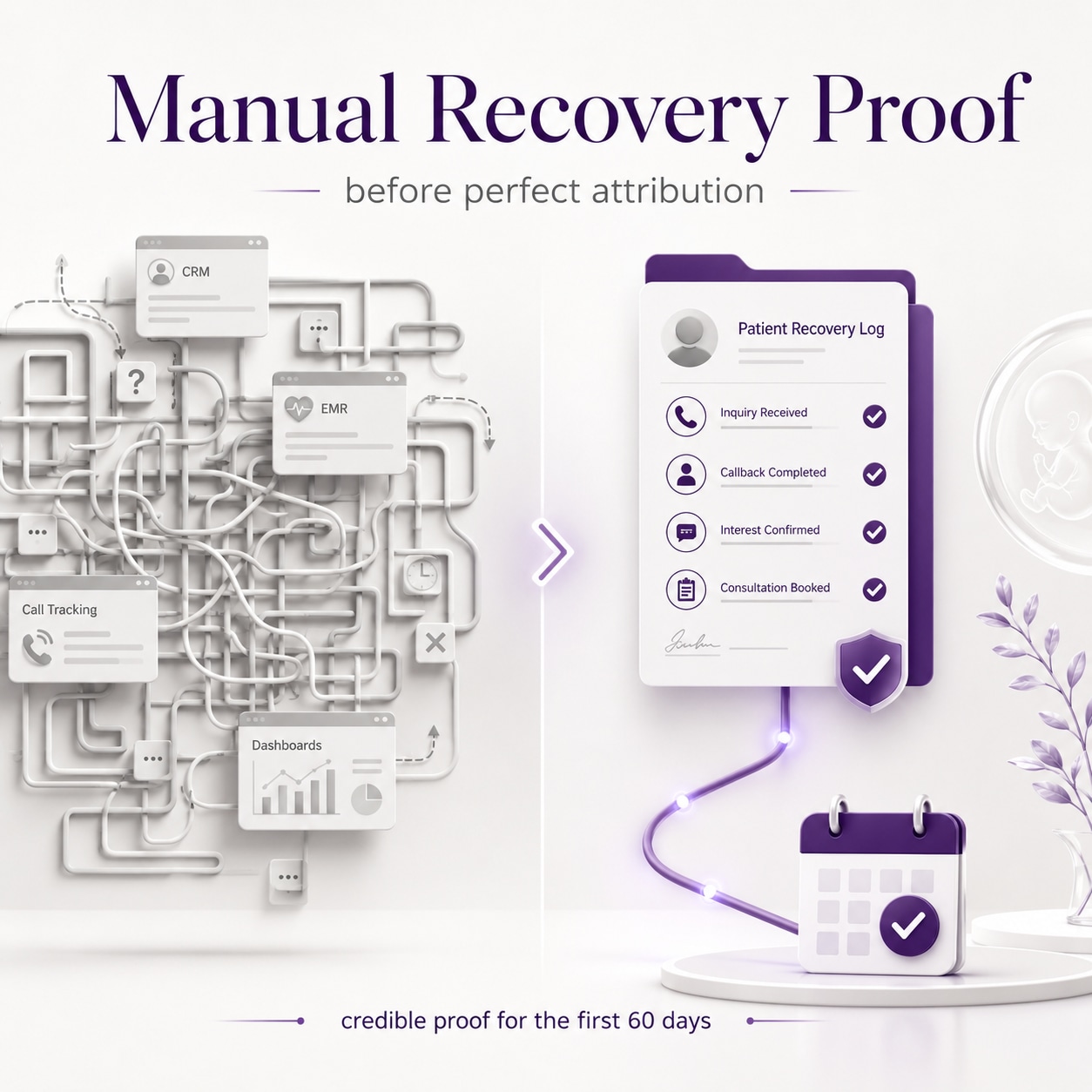
Manual Recovery Proof Beats Perfect Attribution in the First 60 Days
Manual recovery proof provides a credible alternative to perfect attribution during the first sixty days of a pilot by logging explicit recovery actions alongside confirmed lead lifecycle progress. This approach prevents expensive data gaps and builds trust with stakeholders by using a simple six field log to demonstrate that systematic interventions preceded successful outcomes before complex technical integrations are complete.
Your leads are going cold. You suspect the fertility clinic consult funnel is leaking revenue, and you can feel it in the intake team's weekly numbers. But the CRM isn't connected, the EMR export is queued behind two other IT projects, and the attribution dashboard you were promised is three integrations away. So nothing gets measured, and nothing gets proved.
Waiting for perfect attribution in the first 60 days is a choice to learn nothing. Manual recovery proof, done with proper logging, is a credible alternative for IVF revenue proof. It's not a compromise. It's the fastest path to real pilot data.
Key Takeaways
Attribution paralysis is expensive - Every week without a recovery log creates a permanent data gap that can't be filled later.
Manual recovery proof requires two conditions - An explicit recovery action must be logged, and the same lead must later show lifecycle progress. Both are needed.
Six fields make a log entry count - Action type, contact method, timestamp, lead identity, trigger reason, and downstream outcome. Miss one and the entry becomes noise.
Manual proof is not causal proof - It shows an action was taken and a lead moved forward. It does not prove the action caused the movement. Label it correctly.
A CSV work file creates a learning loop - You don't need a CRM or EMR integration to start tracking recoveries weekly and spotting patterns.
Honest scoping builds trust - A vendor or operator who labels proof levels correctly is more credible to finance leaders and boards than one who inflates claims.
Why Attribution Paralysis Costs More Than Imperfect Proof
The pattern is familiar. A clinic decides to pilot a recovery tool but defers IVF pilot measurement until the tech stack is clean. The CRM needs a new field mapping. The EMR export needs compliance review. The attribution model needs call tracking, form tracking, and a data warehouse to stitch them together. So the proof loop slips by quarters, not weeks.
The compounding cost of that delay is often invisible. Every week without a recovery log is a week of lead movement that cannot be retrospectively confirmed. If a missed-call lead booked a consult three weeks ago and nobody logged the recovery attempt, that data point is gone. The gap is permanent, not pausable. You can't rewind the funnel.
There's also an important distinction between two types of imperfect proof. The first is a gap-filled attribution model that presents estimates as facts, filling in missing data with assumptions and calling it "recovered revenue." The second is a manually logged action with honest scope: it presents what was observed and what was confirmed, and it labels the limits of the claim. The second type is commercially safer for first pilots because it doesn't require anyone to trust a black-box model. It requires them to read a log.
What Manual Recovery Proof Actually Means
Manual recovery proof exists when two conditions are met: an explicit recovery action is logged, and later lifecycle progress for that same lead is confirmed. Both conditions must be true. One without the other doesn't qualify.
To be clear about what manual recovery proof is not: a dashboard estimate, a traffic uplift, a form submission count, or a "likely recovered" model output does not meet this definition. These are useful data points in other contexts, but they don't constitute proof that a specific recovery intervention preceded a specific lead's forward movement.
Why do both conditions matter? The action log establishes that a human (or system) intervened on a specific lead at a specific time. The lifecycle confirmation establishes that the lead actually moved, from inquiry to booked consult, from no-show to rescheduled appointment, from stalled to active. Without the second condition, the action is recorded but the outcome is unknown.
In the framework Irresist Recovered Revenue uses, manual recovery proof is one of three proof levels, positioned as the practical entry point. Baseline-adjusted estimates and causal lift proof come later, when more data and stronger measurement designs become available.
The Six Fields That Make a Log Entry Count
Six fields form the minimum viable proof record for IVF lead recovery. Miss any one of them, and the log entry drops from proof to noise.
Action type - What was done (missed call recovery, unresponded inquiry follow-up, re-engagement outreach). Without this, the log can't be reviewed for patterns or reproducibility.
Contact method - How the lead was reached (phone callback, SMS, email). This confirms contact was actually attempted and allows channel-level learning.
Action timestamp - When the action was taken. This enables sequence analysis and confirms the action preceded any downstream movement.
Lead identity - A stable identifier that can be matched to the same lead in lifecycle data. Without this, downstream confirmation is impossible.
Trigger reason - What prompted the action (missed call flag, inquiry age threshold, consult no-show). This distinguishes systematic recovery from random outreach.
Downstream outcome - What happened next: consult booked, consult attended, still pending, lost, deferred. This is the lifecycle progress that completes the proof.
Here's what a complete log row looks like compared to an incomplete one:
| Field Name | Complete Entry Example | Incomplete Entry Example | Why It Fails Without This Field |
|---|---|---|---|
| Action type | Missed call recovery | (blank) | Cannot identify what recovery pattern was applied |
| Contact method | Phone callback | (blank) | No proof that contact was attempted; no channel learning |
| Action timestamp | 2026-06-03 10:14 AM EST | "last week" | Cannot confirm the action preceded the outcome |
| Lead identity | LEAD-4821 | "a patient who called Tuesday" | Cannot match to lifecycle data for downstream confirmation |
| Trigger reason | Missed call flag, 2-hour window | (blank) | Cannot distinguish systematic recovery from ad hoc outreach |
| Downstream outcome | Consult booked 2026-06-06 | (blank) | Action is logged but outcome is unknown; proof is incomplete |
Manual Proof vs. Causal Proof: Where the Claim Ends
The distinction is straightforward: manual recovery proof shows that an action was taken and that a lead later progressed. It does not prove the action caused the progression.
This matters for IVF specifically because lead-to-consult cycles in fertility clinics can span weeks to months, involve multiple touchpoints, and be influenced by factors that recovery actions can't control. Following up with patients in the right, systemized way, after their initial consultations, is the quickest way to convert more new patients to IVF cycles. But financing decisions, partner alignment, and treatment timing all play roles that sit outside any single recovery action. "The Post Consult Black Hole" is a phenomenon experienced by almost every fertility center, and the reasons leads re-emerge from it are often multi-factorial.
Causal proof would require a holdout group, a controlled comparison, and a longer observation window. None of these are realistic in a 60-day first pilot where the goal is to demonstrate that recovery operations are worth continuing, not to publish a peer-reviewed study.
Honest scoping is a feature, not a limitation. A vendor or operator who labels assisted recovery proof correctly is more trustworthy than one who presents correlation as causation. This matters when you're reporting to finance leaders and boards who will ask pointed questions about what the numbers really show. Irresist Recovered Revenue labels proof levels explicitly so that the ROI check reflects the actual evidence available, not an inflated claim.
Building a Weekly Learning Loop Before Integration
You don't need a connected CRM or EMR to start building IVF revenue proof. A CSV work file or equivalent lightweight export creates a proof loop that can run independently of your broader tech stack.
The weekly rhythm looks like this: log recovery actions as they happen during the week, using the six required fields. At the end of each week, update lifecycle outcomes (booked, attended, no-show, lost) from whatever system the intake team already uses, whether that's the EMR, a scheduling tool, or even a shared spreadsheet. Then review which action types and trigger reasons produced the most downstream movement.
This loop reveals patterns quickly. Which lead segments are leaking the most? Missed calls, unresponded web inquiries, and consult no-shows often represent the highest-volume categories of fertility clinic revenue leakage. Which contact methods are producing the most re-engagement? Is the volume of logged recoveries large enough to justify a deeper integration investment?
Think of manual-first as a sequencing strategy. The proof loop identifies which integrations are worth building. It's not a permanent workaround. It's a way to avoid building expensive integrations for problems that turn out to be small.
One safety note: lead identifiers should be scoped and masked where possible. Full PII should not be the default export format. The log should be validated before use in reporting, and your team should agree on identifier handling before the first row is logged.
Pilot Proof Checklist
This is the practical deliverable. Apply it before your first recovery action is logged.
Pre-Pilot Setup
Create a log template with all six required fields (action type, contact method, timestamp, lead identity, trigger reason, downstream outcome)
Define eligible recovery reasons (which trigger types qualify for logging)
Define who can log recovery actions (intake staff, recovery operator, both)
Identify the outcome tracking source (EMR, scheduling system, shared sheet)
Agree on proof level labels with stakeholders (manual proof, baseline-adjusted estimate, causal lift) so reporting expectations are set before data arrives
Select initial lead segments for the pilot (start with missed calls, unresponded web inquiries, or consult no-shows)
Per-Action Logging
Log the action type for every recovery attempt
Log the contact method used
Log the action timestamp in your clinic's local timezone
Log the lead identity using a stable, matchable identifier
Log the trigger reason that prompted the action
Update the downstream outcome as lifecycle data becomes available
Validate before closing the row: if lead identity or downstream outcome is missing, flag the entry as incomplete and exclude it from proof reporting until updated
Any log entry missing the lead identity or downstream outcome field should be treated as incomplete. It can stay in your working file, but it doesn't count as manual recovery proof until both conditions are met.
The Bottom Line
Perfect attribution is a worthy goal. It's also a terrible reason to delay learning whether your fertility clinic consult funnel has recoverable revenue sitting in it right now. Manual recovery proof, built on explicit action logs and confirmed lifecycle movement, gives you credible IVF revenue proof in weeks, not quarters.
The cost of waiting isn't just delayed insights. It's a permanent data gap. Leads that move, stall, or leave during a measurement blackout can never be retrospectively confirmed. Every week you log is a week you can learn from. Every week you don't is gone.
If you're evaluating whether a recovery proof loop is practical for your clinic, Irresist Recovered Revenue is built to produce manual recovery proof before full CRM or EMR integration. The ROI check labels what the evidence shows, not what a model guesses. Request a Revenue Leak Map to see whether your clinic has recoverable consult volume worth logging.
FAQ
What counts as manual recovery proof in an IVF pilot?
Manual recovery proof requires two conditions: a specific recovery action must be logged (with action type, contact method, timestamp, lead identity, and trigger reason), and later lifecycle progress for that same lead must be confirmed (consult booked, consult attended, etc.). A model estimate, dashboard metric, or traffic change does not qualify. Both the action and the confirmed outcome are required.
Can a clinic run a proof loop without connecting its CRM or EMR?
Yes. A CSV work file with the six required fields (action type, contact method, timestamp, lead identity, trigger reason, downstream outcome) can serve as the proof log. Lifecycle outcomes are updated weekly from whatever system the intake team already uses. Lead identifiers should be scoped and masked rather than exported as full PII, and the log should be validated before use in any reporting.
How is manual recovery proof different from saying the tool recovered a patient?
Manual recovery proof asserts that a recovery action was logged and that the lead later progressed. It does not assert that the action caused the progression. Saying "the tool recovered a patient" implies causation, which would require a holdout group and controlled comparison. The distinction matters for honest reporting, and it's the reason Irresist labels proof levels explicitly.
What happens to proof quality as the pilot scales beyond 60 days?
Manual recovery proof is the entry point. As data volume grows and baseline assumptions become available, the proof can progress to baseline-adjusted estimates, which compare current-period outcomes against expected performance. Causal lift proof, requiring holdout groups or controlled measurement, becomes relevant only when the recovery operation is mature enough to justify the design complexity, typically well beyond the initial pilot.
Which lead segments should a fertility clinic prioritize first when building a manual recovery log?
Start with missed calls, unresponded web inquiries, and consult no-shows. These three segments represent the highest-volume, structurally recoverable leads in most fertility clinics. Missed calls have a clear trigger and a short recovery window. Unresponded inquiries have a timestamp and can be followed up systematically. Consult no-shows are already in the scheduling system, making lifecycle tracking straightforward. All three give you the fastest path to a populated proof log.