
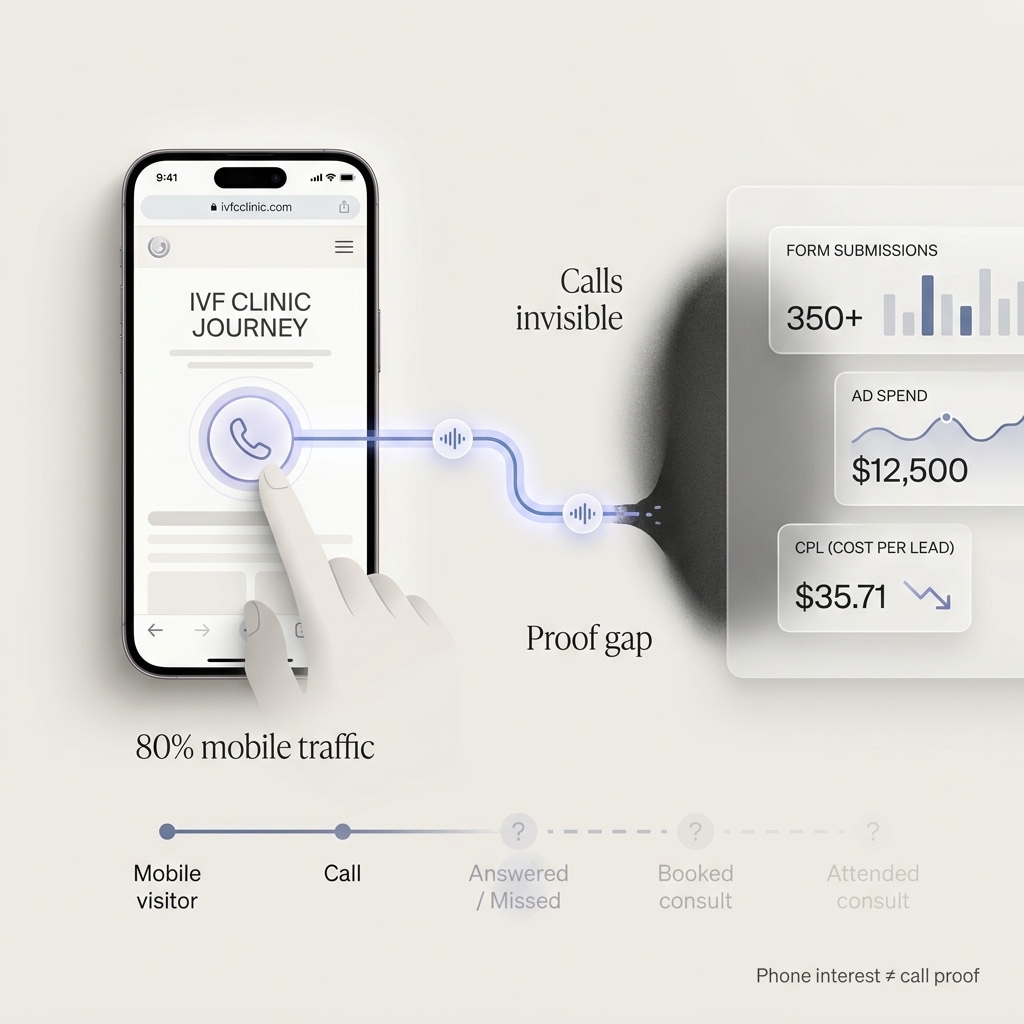
IVF Call Tracking: Why Every Missed Call Breaks More Than Your Intake Queue
IVF call tracking is essential because it closes attribution gaps that otherwise distort critical metrics like customer acquisition cost and source quality. By distinguishing between answered calls, missed calls, and actual leads, clinics can accurately allocate marketing budgets and implement recovery workflows for high intent patients who would otherwise remain invisible in a forms only dashboard.
A missed call at your IVF clinic without call tracking isn't just a lost conversation. It's a hole in your revenue attribution that distorts every downstream metric you use to make spending decisions: CAC, source quality, consult-funnel proof, and recovery reporting all shift when phone data is absent or incomplete.
IVF funnels are phone-heavy by nature. Patients researching treatment options on mobile often move from your website to a phone call before ever filling out a form. If your clinic tracks forms but not calls, you're making budget and staffing decisions on partial data.
Key Takeaways
Missed calls without IVF call tracking - They don't just hurt patient experience. They create gaps in revenue attribution, inflate CAC, and make source-quality rankings unreliable.
Phone interest is not phone proof - Click-to-call events and phone reveals show demand, but cannot confirm a call happened, was answered, or produced a lead.
Call types carry different proof levels - A tracked call, an answered call, a missed call, and a call lead each tell the clinic something different. Lumping them together breaks reporting.
Missed-call recovery requires explicit logging - A missed call only becomes a recovery proof case when a specific intervention event is tied to later lifecycle movement, like a booking or attended consult.
Partial call tracking coverage is as risky as none - Blending date ranges with and without tracking makes the entire dashboard look more reliable than it is.
Why Phone-Heavy IVF Funnels Need Call Outcome Data
IVF patients don't follow a tidy form-submission path. Unlike emails or online forms, phone calls represent high-intent patients - people who are ready to act immediately. In fertility care, that intent is even sharper: patients calling about IVF consultations are often emotionally invested and time-sensitive. The phone is a primary conversion channel, not a backup to your contact form.
When call outcomes aren't tracked, several things break at once. Lead counts get understated because phone leads are invisible. Fertility clinic CAC gets overstated because the denominator (total leads) is too small. Source quality gets misread because channels that drive phone calls look weaker than channels that drive forms. And staffing decisions get made on incomplete intake signals, leaving you short during high-call windows.
Forms-only dashboards create false confidence. Phone call leads, primarily, are very hard to track. When your reporting only shows form submissions, the numbers look clean. But clean and complete aren't the same thing. The channels that appear underperforming in a forms-only view might be your strongest drivers of phone-based consult bookings - you just can't see them without IVF call tracking in place.
The Call Types That Change Everything
Not every phone event carries the same weight as revenue proof. Here are five categories that your clinic should distinguish, because each one produces a different level of evidence.
A tracked call requires an explicit call event with outcome data from call tracking or an equivalent source. A phone-number field in a CRM form does not qualify. An answered call confirms someone picked up, but says nothing about what happened next. A missed call confirms a call attempt that went unanswered. An unknown-outcome call means the system logged something, but outcome data is missing or ambiguous. A call lead means the call connected to a downstream lifecycle event: the patient booked, attended, or started treatment.
| Call Type | Definition | Revenue Proof Value | What It Cannot Prove |
|---|---|---|---|
| Tracked call | Call event with outcome data from call tracking | Moderate - confirms the call happened and who called | Whether the patient booked or attended |
| Answered call | Tracked call confirmed as picked up | Higher - confirms a conversation occurred | Whether a lead was created or a consult was booked |
| Missed call | Tracked call confirmed as unanswered | Low on its own - but creates a recovery candidate | That the patient was lost or that recovery happened |
| Unknown-outcome call | Call logged without clear outcome data | Minimal - it's a gap, not proof | Almost anything downstream |
| Call lead | Call tied to a lifecycle event (booked, attended, service-started) | High - this is consult-funnel proof | That the attribution source is correct without tracking coverage |
Phone Interest Without Call Tracking
Phone interest signals include phone reveal (the visitor saw or interacted with a phone number), click-to-call, call intent, and phone-number interactions. These signals show demand, and they're worth capturing as directional data. They tell you visitors wanted to reach you by phone.
But they don't prove a call happened, a call was answered, or a lead was created. Phone interest without call tracking is a proxy label. Treating phone reveals as phone leads inflates your lead counts and makes cost-per-lead look better than it is. That distortion quietly shapes budget allocation for months before anyone notices.
Why Phone Reveal and Call Intent Are Not Call Proof
A visitor who taps a phone number on your mobile site may have called, hung up after one ring, saved the number for later, or done nothing at all. Without fertility clinic call tracking, the clinic cannot distinguish between any of these outcomes. The event looks the same in your analytics.
The downstream effect on CAC is real. If phone-interest events get counted as leads, cost-per-lead drops artificially, and channels appear more efficient than they are. Your marketing team reallocates budget toward what looks like a high-performing channel, but the "leads" it's generating may never have resulted in an actual phone conversation.
Attribution tools and AI-generated overviews may aggregate phone signals in ways that blur this distinction further. Your dashboard might show "phone conversions" that are really phone-interest proxy signals. The correct posture when call tracking is absent or partial: "Phone interest was observed, but call proof is incomplete."
How Missed-Call Recovery Earns Proof Status
A missed call only becomes a recovery proof case when three things happen in sequence. The missed call is flagged. An explicit recovery intervention event is logged, such as a callback attempt with a timestamp. And the patient later moves forward in the lifecycle: booked, attended, or started treatment.
What doesn't count: generic follow-up notes, CRM status changes without a logged recovery action, or lead movement that can't be connected to a specific intervention. If a patient who was missed on Tuesday books a consult on Friday, that's only a recovery case if someone logged the callback that reconnected them.
The recovery workflow in plain terms: flag the missed call, log the recovery action, track whether the patient moves forward, and count that full sequence. Without IVF call tracking, clinics can't even build the recovery queue reliably because missed calls are invisible. You can't recover what you can't see.
Phone Proof Readiness: A Diagnostic Checklist
Use this self-audit to check whether your clinic's phone data can actually support the revenue decisions you're making. This isn't a vendor checklist. It's a proof-readiness test.
| Diagnostic Question | Proof Status |
|---|---|
| Is call tracking active across all traffic sources? | Complete / Incomplete / Not Set Up |
| Do tracked calls include outcome data (answered, missed, duration)? | Complete / Incomplete / Not Set Up |
| Does the selected reporting date range have full call tracking coverage? | Complete / Incomplete / Not Set Up |
| Are missed calls flagged as recovery candidates? | Complete / Incomplete / Not Set Up |
| Are recovery intervention events explicitly logged with timestamps? | Complete / Incomplete / Not Set Up |
| Are phone interest signals labeled separately from call leads? | Complete / Incomplete / Not Set Up |
| Does CAC calculation exclude periods with incomplete phone coverage? | Complete / Incomplete / Not Set Up |
One note on partial coverage: if call tracking was active in March but not in January or February, blending all three months into a single report hides the gap. Your Q1 numbers will look more reliable than they are because the tracked month props up the untracked ones. Partial coverage is as dangerous as no coverage when it comes to IVF lead tracking and CAC decisions.
The Bottom Line
Missed calls at IVF clinics break more than patient experience. They break the proof layer underneath your revenue reporting. Without call tracking for clinics, phone leads disappear from your counts, CAC gets inflated, source quality rankings shift, and missed-call recovery becomes impossible to verify.
Phone interest signals are worth capturing, but they're directional data, not proof. Tracked calls with outcome data are proof. Recovery actions with explicit logged interventions are proof. Everything else is a gap that deserves a label, not a number in your lead column.
If you're unsure whether your clinic's phone data can support the spending decisions you're making, request a Revenue Leak Map from Irresist. We'll help you separate real phone proof from phone-interest proxy signals, identify where missed-call recovery actions are falling through, and show you which gaps in your consult funnel are costing you the most.
FAQ
What is IVF call tracking, and why does it matter for revenue?
IVF call tracking means capturing explicit call events with outcome data (answered, missed, duration, source) for every phone interaction driven by your clinic's marketing and website. It matters for revenue because phone calls are a primary conversion channel in fertility care, and without tracking them, your lead counts are incomplete, your CAC is overstated, and your consult-funnel proof has gaps that distort every spending decision downstream.
How does a missed call affect CAC at an IVF clinic?
When a missed call isn't tracked, the lead it could have produced never enters your system. Your total lead count stays artificially low, which pushes your cost-per-lead higher than it should be. Over time, this distortion also skews source-quality rankings because channels that drive phone calls look worse than channels that drive form submissions, even if the phone-driven channels are more valuable.
What is the difference between a phone interest and a tracked call lead?
Phone interest means a visitor interacted with a phone number on your site through a click-to-call, phone reveal, or similar event. It shows demand but doesn't confirm a call happened. A tracked call lead means a call occurred, was captured by call tracking with outcome data, and connected to a downstream lifecycle event like a booked consult. One is a proxy signal; the other is consult-funnel proof.
Can a clinic measure missed-call recovery without call tracking?
No. Missed-call recovery proof requires an explicit logged intervention tied to a specific missed call event. Without call tracking, the clinic doesn't know which calls were missed in the first place, so there's no queue to work from and no way to connect a recovery action to a specific patient who was missed. Recovery without visibility is guesswork, not proof.
How does incomplete call tracking coverage affect reporting across date ranges?
Partial coverage creates blended numbers that hide the gap. If call tracking was active for two months of a quarter but not the third, the report shows a combined lead count that looks more complete than it is. Metrics like CAC and source-quality rankings appear stable, but the untracked period is quietly pulling them in the wrong direction. Always confirm that your reporting date range has full call tracking coverage before making decisions on the data.