
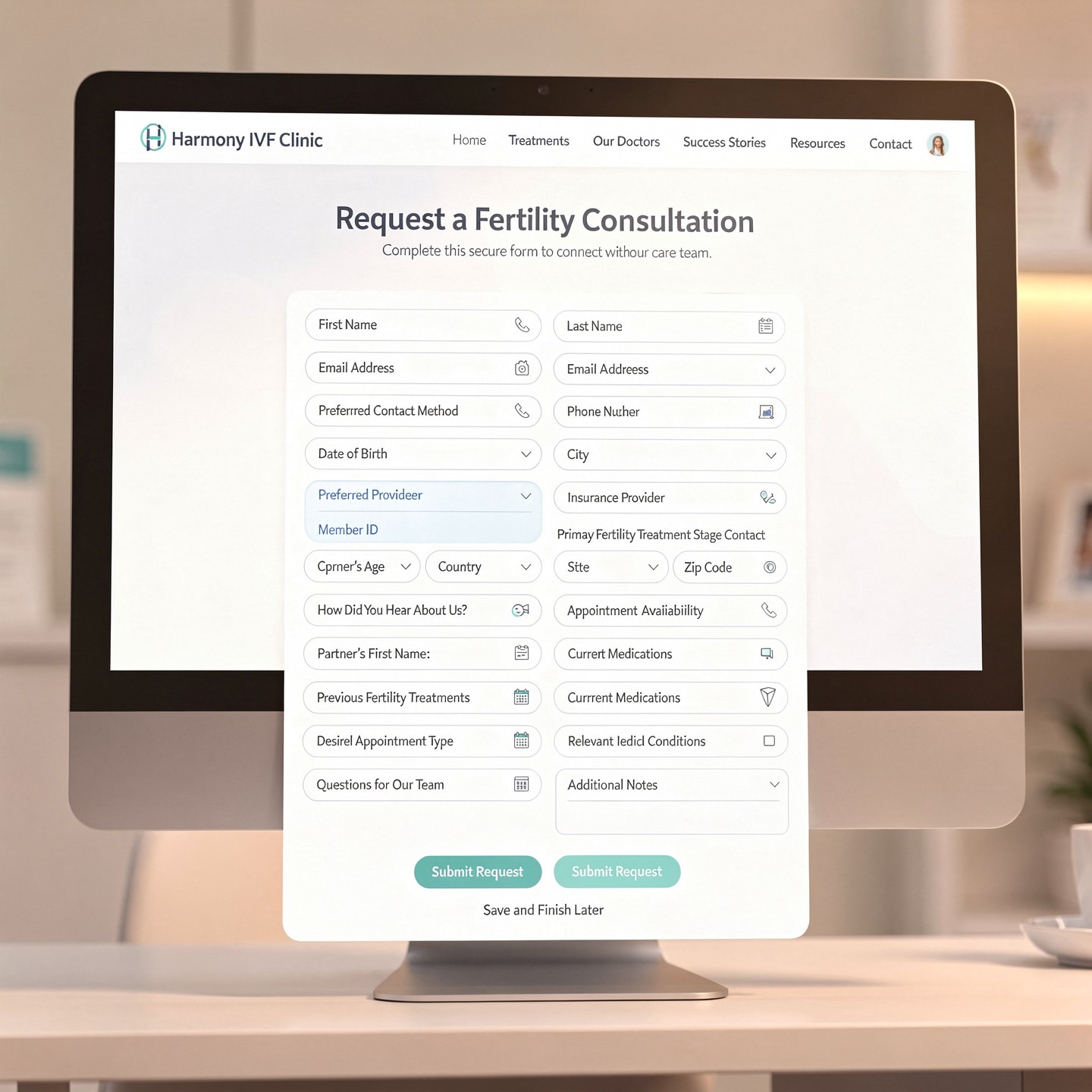
How to Design an IVF Lead Form That Patients Actually Complete
An effective IVF lead form prioritizes trust by separating the initial inquiry from the full clinical intake process. To maximize completions, clinics should limit required fields to basic contact information and provide a clear explanation of who will respond and when the patient can expect a callback.
A patient finds your clinic. They click through to your contact page. They start filling out your IVF lead form: name, email, phone, date of birth, diagnosis history, previous cycles, partner details, and somewhere around field seven, they close the tab. They don't come back. They complete a shorter form on another clinic's site instead.
This is not a traffic problem. You already won the click. This is a form design problem. A mismatch between what your clinic asks for and what the patient is ready to give at first contact.
The IVF lead form is not an administrative tool. It is the first trust moment between a vulnerable patient and an unfamiliar clinic. Most clinics treat it like a mini intake questionnaire, and the result is predictable: high-intent patients leak out at the exact moment they were ready to reach out.
This article breaks down why IVF forms underperform, the structural fix that separates first contact from full intake, what to measure, and the specific mistakes to stop making today.
Key Takeaways
First contact is not intake - Separate initial inquiry (name + one contact method) from clinical data collection, which belongs after trust is established.
Every required field has a drop-off cost - IVF patients aren't avoiding your clinic; they're avoiding friction at a moment of high anxiety and low trust.
"What happens next" matters as much as the form - A single sentence explaining who responds and when can reduce form abandonment significantly.
Mobile is where most IVF forms break - The majority of clinic traffic arrives on phones, yet most forms were designed and tested on desktop.
Measure more than submissions - Track form start rate, completion rate, field-level drop-off, and time-to-first-response to find where patients actually leave.
Why IVF Lead Forms Are a Different Problem
IVF patients are not buying software or booking a restaurant. They're navigating one of the most emotionally charged decisions of their lives, often comparing three to five clinics at once. They're anxious, uncertain, and not yet ready to hand over personal medical details to a clinic they haven't spoken with.
In lower-stakes industries, a long form is tolerable. In fertility, the form arrives at the peak of patient vulnerability. Asking for diagnosis history, previous treatment cycles, and partner information before a single conversation has happened is asking for trust that hasn't been earned yet.
High-intent patients are not lazy. They will complete a detailed form for a clinic they trust. The problem is that your form demands trust before it has been established. At Irresist, we see this pattern constantly: when a visitor reaches an IVF patient inquiry form, their intent is already high. The form should not be the thing that filters them out.
A lost IVF form completion is not just a missed inquiry. It is a patient who finishes that form on a competitor's website instead of yours.
The Structural Fix: First-Contact Form vs. Full Intake Form
The fix is structural. Separate the first-contact form from the full intake form. The first-contact form handles initial inquiry only. The full intake form is collected after trust is established, i.e., after a call, after a consultation is booked, or after the patient has had a real interaction with your team.
A first-contact form needs three things: name, one contact method (email or phone - not both required), and an optional open field like "What would you like to discuss?" That's it.
Everything else, diagnosis history, previous cycles, partner details, insurance, referral source, date of birth, belongs in intake, not first contact. Each additional required field has a measurable drop-off cost. IVF patients aren't avoiding your clinic. They're avoiding the friction at this specific moment.
| First-Contact Form | Full Intake Form | |
|---|---|---|
| Purpose | Start the conversation | Collect clinical detail |
| Number of fields | 3-4 | 15-30 |
| Medical questions | None | Yes, detailed |
| Required fields | Name + one contact method | All relevant clinical fields |
| When collected | First website visit | After initial contact or booking |
| Goal | Get a response started | Prepare for consultation |
The two-stage approach lets you improve fertility clinic lead conversion without cutting lead quality. You still collect the same information. Just at the point when patients are actually willing to share it.
Designing the Form: What to Include, What to Cut
Name and one contact method should be the only required fields on a first-contact fertility clinic lead form. Everything else is optional. If you want to include an open-text field or a dropdown for inquiry type, make it optional and keep it short.
Your CTA button matters more than you think. "Submit" tells the patient nothing. "Request a Call" or "Start My Consultation" tells them what they're agreeing to and what happens next. The button should describe an action and an outcome.
Trust signals near the submit button reduce hesitation. A one-line privacy reassurance ("We won't share your information"), the name or title of the person who will respond, and an expected response time all help. Patients abandon forms when they can't visualize what submitting will trigger. One sentence below the CTA explaining the next step can change completion rates; this is the core idea behind The Biggest IVF Website Leak: "I Don't Know What Happens Next".
Finally, place alternative contact paths near the form. A visible phone number, a callback option, or a "Speak to a patient coordinator" link gives patients who aren't ready for the form another way in.
| Common Mistake | Why It Hurts Conversion |
|---|---|
| Too many required fields | Each field adds friction; patients leave before finishing |
| Medical history at first contact | Asks for trust before it's earned |
| Vague CTA ("Submit") | Patient doesn't know what happens next |
| No explanation of who responds or when | Creates uncertainty, increases abandonment |
| No privacy reassurance near submit | Patients hesitate to share contact details |
| No alternative contact path | Loses patients who prefer a call or callback |
Mobile UX: Where Most IVF Forms Break
Most IVF clinic website traffic arrives on mobile, especially from social and search. Yet most clinic forms were designed on desktop and have never been tested on a phone.
The practical issues are specific: fields that require zooming, dropdowns that are hard to tap, keyboards that cover the submit button, and forms that don't support autofill. Any one of these can kill IVF form completion on mobile.
Mobile testing should be part of every form audit. That means clicking through the entire form on an actual phone, on a real connection, not a desktop simulator. For a deeper look at this gap, see Mobile-First IVF: Why Most Clinics Still Design for the Wrong Device.
Response time also matters more on mobile. A patient who submits from their phone while comparing clinics expects a fast reply. A 48-hour response window isn't just a service issue. It's a conversion problem.
What to Measure
Most clinics track total form submissions and nothing else. That tells you how many people crossed the finish line, but nothing about where the others dropped off. Here are the four metrics every IVF clinic should track on its lead form:
| Metric | What It Tells You | Where to Find It |
|---|---|---|
| Form start rate | How many visitors begin the form vs. view the page | Tag manager + analytics event |
| Form completion rate | What percentage of starters actually submit | Tag manager + analytics event |
| Field-level drop-off | Which specific field causes abandonment | Form analytics tool (e.g., Hotjar, Zuko) |
| Time-to-first-response | How long between submission and clinic's first reply | CRM or manually tracked |
| Page-level conversion rate | What share of page visitors convert to any action | Analytics platform |
GA4 alone is typically not enough for this level of measurement. For more on that gap, see Why GA4 Is Not Enough for IVF Clinics.
At Irresist, we track forms alongside calls and key actions, validate uplift through controlled measurement, and run a weekly optimization loop. That's how fertility clinic website conversion improvement becomes a process, not a one-time fix. For a broader look at what drives booked consultations, see Fertility Clinic Marketing: What Actually Drives Booked Consultations in 2026.
The Bottom Line
The best IVF lead form is short, clear, and honest about what happens next. It collects just enough to start a conversation: name and one contact method, and saves clinical detail for after trust is established.
If your form asks for medical history, partner details, and insurance information before a patient has ever spoken to your team, you're losing completions to clinics with simpler forms. That's not a traffic problem. It's a design problem with a clear fix.
Audit your form on a real phone. Cut required fields to a minimum. Rewrite your CTA to describe what happens next. Add a privacy line and an alternative contact path. Then measure form start rate, completion rate, field-level drop-off, and time-to-first-response - weekly, not quarterly.
If you want a simple IVF Lead Form Review Checklist, contact Irresist.
FAQ
What fields should an IVF lead form include?
At first contact, the only required fields should be name and one contact method (email or phone). An optional open-text field for "What would you like to discuss?" can help, but everything else, like medical history, partner details, and insurance, belongs in the intake form collected after initial contact is established.
Why do patients abandon IVF lead forms?
The most common causes are too many required fields, medical history questions appearing too early, a vague CTA like "Submit" that doesn't explain what happens next, and no indication of who will respond or when. These friction points compound, and each one gives an anxious patient another reason to close the tab.
How is a first-contact form different from an IVF intake form?
A first-contact form collects only enough information to begin the relationship. Typically name and one contact method. An intake form collects detailed clinical information (diagnosis, treatment history, partner details) and is completed after trust has been established through an initial conversation or booked consultation.
How quickly should a clinic respond to a lead form submission?
Response time is part of conversion, not just customer service. Same-day responses significantly outperform 24- to 48-hour windows, especially when patients are actively comparing clinics. Not to mention that responses within a 5-minute window win and can literally quadruple your conversion rate. A patient who submits a form on three clinic websites is likely to book with whoever responds first.
How do IVF clinics measure lead form performance?
The core metrics are form start rate, form completion rate, field-level drop-off, and time-to-first-response. Most clinics only track total submissions, which misses the diagnostic data that reveals where and why patients leave. GA4 alone rarely captures all of these - dedicated form analytics tools and CRM tracking are typically needed.