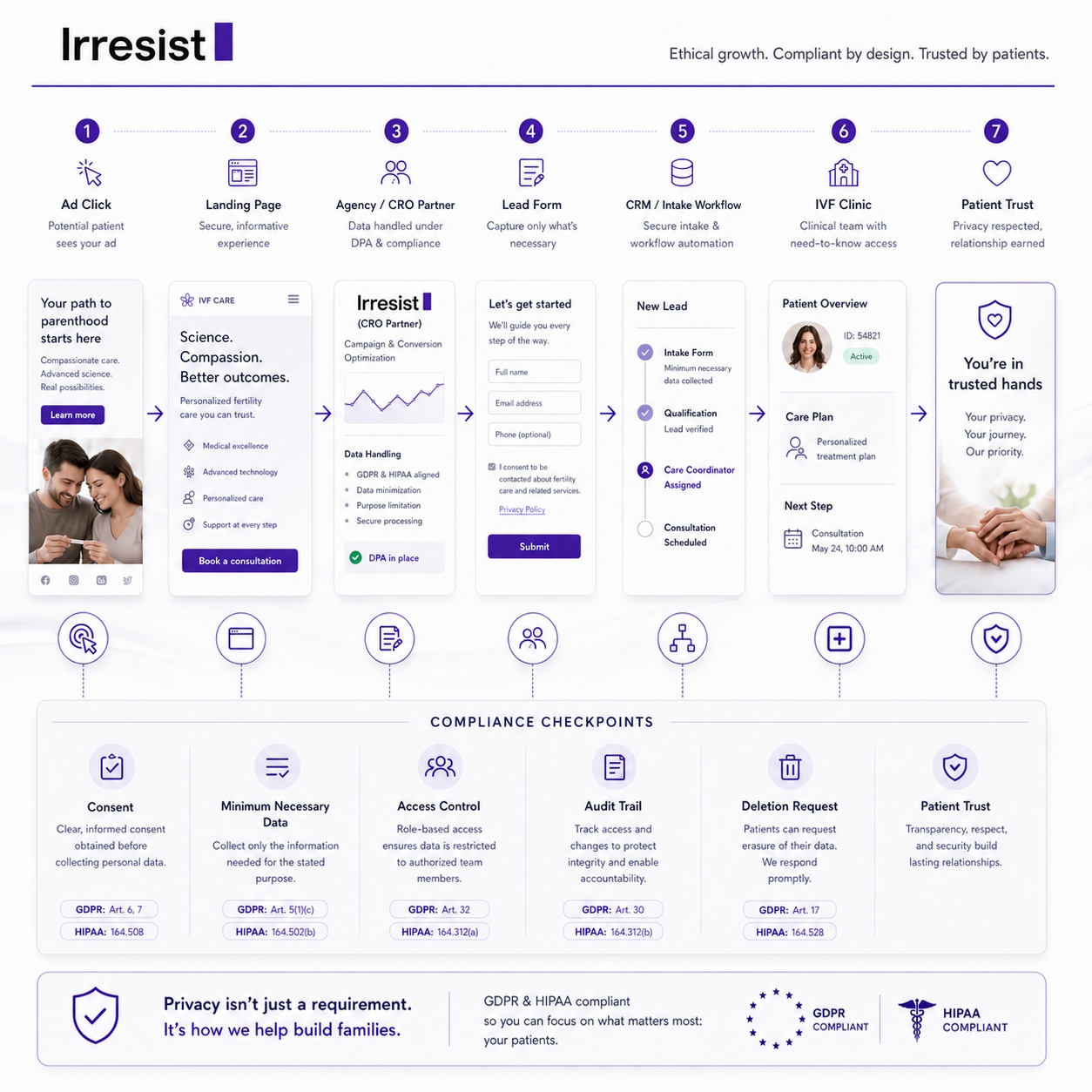
GDPR and HIPAA for IVF Clinics: Why Compliance Must Extend Across Marketing, Lead Handling, and Patient Trust
IVF clinics must extend GDPR and HIPAA compliance beyond the electronic medical record to include every marketing touchpoint where health related context is captured or shared. This comprehensive approach requires securing the entire data path from initial ad clicks and web form submissions to CRM synchronization and external agency reporting to ensure patient trust and regulatory alignment.
Most conversations about GDPR and HIPAA for IVF clinics start in the wrong place. They focus on the EMR, the patient record system, or the clinical database. Those matter. But the compliance exposure that catches fertility clinics off guard tends to live earlier in the patient journey: the ad click, the form submission, the callback request, the CRM sync, the export to an agency dashboard.
A prospective patient who fills out a form on a page about failed IVF cycles has already shared something more sensitive than a name and phone number. The context of the page, the intent behind the visit, and the information entered at intake create a data profile that sits in a different risk category from a generic lead. And if an agency, lead provider, or CRO partner touches that data without appropriate controls, the clinic inherits the exposure.
This article walks through why IVF patient data compliance requires a higher bar, where risk actually appears in the lead-to-patient journey, what clinics should expect from external partners, and what good operational compliance support looks like in a modern growth stack. This is not legal advice. It is a practical framework for clinic leaders, growth teams, and marketing partners who want to understand the full picture.
Key Takeaways
IVF lead data carries health-related context - Even early-stage form submissions can go beyond ordinary contact data, triggering stricter handling under GDPR and, where applicable, HIPAA.
Compliance risk starts before the EMR - The full data path from ad click to intake handoff contains multiple exposure points that clinics often overlook.
External partners share the risk - Agencies, CRO teams, and lead providers who see, store, or route patient-related data can create compliance exposure for the clinic.
Patient trust depends on privacy posture - In fertility care, weak data handling harms legal standing, brand credibility, and patient confidence simultaneously.
Operational readiness goes beyond policy - Clinics need vendors who can demonstrate controls through workflows, logs, and evidence, not just contractual language.
GDPR and HIPAA for IVF Clinics: Why Compliance Must Extend Across Marketing, Lead Handling, and Patient Trust
Most compliance thinking in healthcare focuses on systems of record. IVF clinics rightly invest in securing clinical databases and EMRs. But the modern fertility clinic also runs ad campaigns, captures leads through web forms, routes callbacks through intake teams, syncs data into CRMs, and shares reporting with external partners.
Each of those touchpoints can involve data that goes beyond a name and email address. In IVF, a lead captured from a page about egg freezing or recurrent pregnancy loss carries health-related context by default. That context changes the compliance picture.
The risk is three-dimensional. There is legal risk: regulatory frameworks like GDPR and HIPAA set obligations around how this data is collected, processed, shared, and deleted. There is operational risk: systems that cannot support deletion requests, access audits, or controlled exports create gaps that surface during incidents. And there is reputational risk: a patient who learns their fertility-related data was handled carelessly does not blame the agency or the CRM vendor. They blame the clinic.
Compliance in IVF cannot stop at the clinic boundary. It has to follow the data.
Why IVF Clinics Need a Higher Bar for Data Compliance
IVF is categorically different from general healthcare marketing. A prospective patient may disclose or imply fertility status, treatment history, failed-cycle history, reproductive plans, timing preferences, and contact details tied directly to treatment intent. This is not an abstract concern. It happens in every form submission, callback, and intake conversation.
Under GDPR, health-related information qualifies as special-category data under Article 9, requiring stricter justification and handling. Even early-stage lead data in IVF can move beyond ordinary contact data into health-related or treatment-related context, which means clinics and their vendors should operate with a higher standard of care.
Where HIPAA applies and the clinic is a covered entity, protected health information includes data related to past, present, or future health conditions and healthcare services. Fertility clinics in this context must implement the Privacy Rule, Security Rule, and Breach Notification Rule. Major HIPAA Security Rule updates proposed in December 2024 would require stricter business associate compliance, including annual written proof of compliance and 24-hour breach notifications. The rule is expected to become effective in July or August 2026, with most provisions requiring implementation within 180 days.
The broader regulatory environment is tightening. Regulators spent 2025 refining their tools, broadening the set of entities they scrutinize, and tightening expectations around cybersecurity hygiene, vendor oversight, and the responsible use of digital technologies. State attorneys general are likely to continue to focus on health privacy as an enforcement priority, especially as new laws pass and others go into effect.
The business reality is direct: in fertility care, patients are in emotionally sensitive, high-consideration situations. Trust is part of conversion. Weak data handling can harm legal posture, brand credibility, and patient confidence at the same time.
This article does not constitute legal advice. Clinics should consult qualified legal counsel for jurisdiction-specific obligations.
Where Compliance Risk Actually Appears in the IVF Lead Journey
Risk does not concentrate in one system. It accumulates across the full data path: ad click, form start, form submission, callback, CRM sync, export or handoff to external systems, and deletion handling. Each step has its own exposure profile.
The core issue is that PII-only thinking is too narrow for IVF. When someone submits a form on a landing page about failed IVF cycles or donor egg programs, the combination of their contact information and the page context creates a data profile that goes beyond ordinary contact data. No explicit medical fields are required for health-related context to exist.
HHS's Office for Civil Rights has highlighted that regulated entities must ensure they do not impermissibly disclose PHI to tracking technology vendors, noting that "because of the proliferation of tracking technologies collecting sensitive information," it is critical to disclose PHI only as the HIPAA Privacy Rule permits. Single-specialty healthcare organizations should use particular caution, because if your organization only provides a specific service, most pages on your website could point to an individual's specific healthcare needs. This is directly relevant to fertility clinics.
Here is where risk shows up across the journey:
| Stage in Journey | Potential Exposure | Good Practice Standard |
|---|---|---|
| Ad click / landing page | Third-party tracking scripts may transmit health-related browsing data to external vendors | Audit all tracking technologies; restrict scripts on health-specific pages |
| Form submission | Collecting more fields than needed; weak or absent consent capture | Purpose-limited forms; configurable consent collection; minimum-necessary fields |
| Callback / intake | Sensitive context shared verbally or in notes without access controls | Role-based access to call notes; documented handling procedures |
| CRM sync | Full lead profiles replicated into systems with broad user access | Minimum-necessary field mapping; restricted access roles |
| External export / handoff | PII shared downstream to agencies or reporting tools by default | Allowlisted field exports; no default PII sharing; documented decisions |
| Deletion or DSR request | No structured process; no evidence trail; no downstream propagation | Repeatable delete workflows; confirmation from processors; audit evidence |
Why Agencies, CRO Partners, and Lead Providers Must Support GDPR and HIPAA Goals
Under GDPR, the accountability principle is clear: processors and subprocessors must provide sufficient guarantees and operate under appropriate contractual controls. The clinic, as controller, remains accountable for what happens to the data, even when a vendor does the processing.
The HIPAA framing requires more care. Where a vendor creates, receives, maintains, or transmits PHI or ePHI on behalf of a covered entity, that vendor may be acting in a role that creates business associate obligations. This requires a Business Associate Agreement and subcontractor controls**,** where applicable. Not every marketing agency automatically becomes a HIPAA-regulated entity, but clinics should assess each vendor's role and data access carefully. The FTC's Health Breach Notification Rule enforcement and state health privacy statutes now operate in the space where HIPAA does not reach, and covered entities increasingly find themselves accountable not only for their own controls but for the practical downstream realities of their digital ecosystem.
From the patient's perspective, none of this nuance matters. A patient does not know or care which vendor touched their data. They associate every privacy failure with the clinic. A clinic can outsource media buying. It cannot outsource accountability in the eyes of the patient.
The Common Blind Spot
Agencies, CRO teams, and lead providers may see, store, enrich, or route lead data. They may use dashboards or exports with sensitive context. They may influence form design and collection practices. They may become part of deletion or breach-response workflows without the clinic ever having considered this.
Casual use of patient-related data in spreadsheets, shared inboxes, or ad hoc workflows by external teams is a real operational exposure, not an edge case. If your growth model depends on external partners touching lead data, compliance capability has to extend to them.
What Clinics Should Require From Any Partner Handling Lead or Patient Data
This is where abstract policy turns into practical operator guidance. The following checklist is a reference clinics can use when evaluating or auditing any external partner handling lead or patient data.
Vendor Compliance Checklist for IVF Clinics
Purpose-limited data handling - The vendor only processes data for the agreed purpose, not for their own analytics, product improvement, or third-party use.
Minimum-necessary data access - The vendor accesses only the fields required to perform their role. No casual access to full lead profiles.
Role-based access controls - Only named individuals with a legitimate need can view or act on sensitive data.
Auditable access and actions - The vendor can show who accessed what data, when, and why. Not just a policy document, but an actual log.
Controlled export and handoff practices - PII is not shared downstream by default. Sharing sensitive fields is an explicit, documented decision.
DSR support readiness - The vendor can respond to deletion requests, export requests, and retention questions in a structured, evidence-based way.
Deliberate retention policies - Data is not kept indefinitely by default. Retention is defined per data type.
Breach and incident handling - The vendor has a clear process and can notify the clinic within agreed timeframes.
Contractual clarity - Responsibilities are documented, including who is the controller, who is the processor, and who carries liability for specific failure modes.
Human verification in lead capture - Controls that reduce fake submissions and noise inside downstream workflows.
Clinics should ask prospective partners to demonstrate operational evidence for these items, not just confirm policy-level agreement. A signed contract is a starting point. Workflow evidence is what matters when regulators or patients come asking questions.
What Compliance Support Looks Like in a Modern IVF Growth Stack
There is a meaningful difference between legal compliance as a minimum floor and operational compliance readiness as the practical standard a growth system should meet. Legal compliance means having the right policies, agreements, and regulatory filings in place. Operational readiness means you can demonstrate through workflows, controls, logs, and evidence that those policies are actually being followed.
A modern IVF growth stack should not force a tradeoff between performance and privacy readiness. The key capabilities to look for:
Consent capture - Configurable consent collection built into lead capture flows, not added as an afterthought. Consent choices should be recorded and auditable.
Minimum-necessary outbound sharing - Direct identifiers like full name, email, and phone should not leave the system by default. Sharing sensitive fields should be an explicit, allowlisted decision rather than an accidental default.
Read-access auditability - Organizations need to know who accessed sensitive lead data in dashboards or exports. Access review supports compliance confidence and incident reconstruction.
DSR readiness - Structured delete workflows, request status tracking, event evidence, anti-relink safeguards, and scoped export capability. Not just a promise that data can be deleted, but a repeatable process with an evidence trail.
Retention controls - Retention defined by data collection family, not random storage accumulation. Operational data and audit evidence managed intentionally.
Authentication and access hardening - MFA support, secure cookies, lockout and throttling, controlled privileged recovery flows. Protecting sensitive data depends on how people access systems in the first place.
Operational repeatability - Runbooks and evidence-oriented controls for deletion requests, audits, incidents, and access reviews. Compliance is stronger when operators follow repeatable procedures rather than improvising case by case.
Irresist supports compliance readiness across lead capture, consent, minimization, access control, auditability, and downstream data handling, helping IVF clinics build a more defensible compliance posture without trading off growth performance. This does not replace legal compliance requirements or qualified legal counsel; it supports the operational layer that makes policy enforceable in practice.
The Bottom Line
IVF patient data compliance is not a checkbox exercise confined to the EMR. It is a continuous requirement that follows the data from the first ad click through form submission, intake, CRM sync, and every downstream system a partner touches.
The regulatory environment is getting stricter, not looser. Enforcement perimeters are widening. Patients in fertility care are acutely sensitive to how their information is handled, and that sensitivity directly affects whether they trust a clinic enough to book a consultation.
Clinics that treat compliance as an operational capability, built into their growth systems rather than bolted on after the fact, will be better positioned on every dimension: legal defensibility, patient trust, and long-term brand credibility.
FAQ: GDPR and HIPAA for IVF Clinics
Do marketing agencies working with IVF clinics automatically fall under HIPAA?
Not automatically. Where a vendor creates, receives, maintains, or transmits PHI or ePHI on behalf of a covered entity, a business associate relationship may arise. But not every agency is subject to HIPAA by default. Clinics should assess each vendor's role, the data they access, and whether a Business Associate Agreement is needed.
How should an IVF clinic handle patient lead data under GDPR?
Health-related lead data in IVF should be treated as potentially falling under GDPR's special-category provisions. Clinics and their vendors should apply purpose limitation, minimum-necessary processing, documented consent, and defined retention. Even early-stage forms can create health-related data profiles.
What should a fertility clinic require from a lead provider or CRO partner?
At minimum: purpose limitation, role-based access controls, auditable access logs, DSR support readiness, deliberate retention policies, and contractual clarity about data responsibility. See the vendor compliance checklist above.
Why does minimum-necessary data sharing matter specifically in IVF marketing?
IVF lead data carries health-related context even when it does not contain explicit medical fields. Sharing full lead profiles with multiple downstream systems creates unnecessary exposure and increases breach and misuse risk. Restricting outbound data to only what each system needs is a core protective measure.
How do data subject deletion requests affect connected vendors in a healthcare lead workflow?
When a clinic receives a deletion request, the obligation extends to processors and subprocessors who hold the data. Clinics need vendors who can execute structured deletion, confirm completion, and provide evidence. Without this, a deletion request becomes a liability gap.
What is the difference between legal compliance and operational compliance readiness?
Legal compliance is the minimum floor: policies, agreements, and regulatory requirements. Operational readiness means the clinic can demonstrate through workflows, controls, logs, and evidence that those policies are actually being followed. This matters both in audits and in breach scenarios.
Executive Takeaway
IVF data compliance is not an IT project or a legal-only concern. It is an operational requirement that spans every system and partner touching patient or lead data. The regulatory landscape, including GDPR special-category protections, evolving HIPAA Security Rule requirements, and expanding state privacy laws, is moving toward stricter vendor accountability and broader enforcement scope. Clinics that embed compliance support into their growth operations, rather than treating it as a separate workstream, reduce legal exposure, protect patient trust, and build a more credible brand. The vendors you choose and the controls they can demonstrate are part of your compliance posture. Choose accordingly.